

Ashburton Project
Leases
The Ashburton (Lyndon) Project consists of two Exploration Licences E08/2913 and E08/3343 covering 184 blocks or approximately 581km2 in the Gascoyne Mining District of Western Australia. The project is approximately 190km south of Onslow, 240km west of Paraburdoo and 220km north-east of Carnarvon.
Geology
The Lyndon Gold Project is located in the eastern portion of the WINNING POOL – MINILYA 1:250,000 geology sheet SF 50-13, lying east of the Carnarvon Basin within the Paleoproterozoic Burringurrah Domain with an age of 1945 to 1620Ma.
The lease is primarily composed of lower Proterozoic sediments made up of conglomerates through sandstones/wacke, siltstones, shales, BIFs, and cherts. metamorphosed to varying degrees. and intruded by two granitoid types: muscovite-bearing heterogeneous granites and homogeneous biotite-granites. These granites have supplied the heat for the mineralisation and metamorphism.
The project is focused on the Pooranoo Metamorphics (approximately 1758 to 1682 Ma), a Proterozoic sequence mapped as schist, gneiss, and migmatite aligned northwest and bounded by muscovite-biotite granites and granodiorites of the Durlacher Supersuite (circa 1689–1620 Ma). The tenements are transected by two northwest subparallel regional faults, extending from the southeast and marking the tectonic boundary between the Pooranoo Metamorphics (metasediments) and the Durlacher Supersuite granites.
Exploration History
Early exploration comprised small scale prospecting chiefly for gold and base metals which is evident by the number of shallow prospecting pits.
Early exploration around Lyndon Station comprised small scale prospecting chiefly for gold and base metals which is evident by the number of shallow prospecting pits. The main areas of interest include the Lyndon Bettina, Eric’s Find, Broken Thumb and 30 Bob Well which are all coarse gold in small veins and in outcrop..
More recently in the 1980s and 1990s, work comprised geological mapping around known occurrences, trench, rock chip and stream sediment sampling and an aeromagnetic interpretation conducted by Helix Resources over the Lyndon Bettina and 30 Bob Well areas exploration. During 2009-2011.
Integrated Resources Group completed three programs of exploration activities which included prospect scale mapping and rock chip sampling. Results up to 46.5 g/t Au were reported from the mineralised veins at Bettina East.
A total of 31 RC holes were drilled for a total of 1,841m at Eric’s Find, Lyndon Bettina, Bettina East, Skarn, Broken Thumb and Thirty Bob Well prospects with thin unconnected veins that included
- IRBET001: 1m @ 3.43g/t Au from 21m
- IRBET002: 2m @ 32.85g/t Au from 46m
- IRBET008: 1m @ 9.83g/t Au from 56m
- IRBT002: 1m @ 1.88g/t Au from 16m
- IRBW003: 2m @ 1.03g/t Au from 38m
These are typical low grade stratigraphic lode material in thin shales and axial planar veins in coarser sandstones and conglomerates. These fit with the Gold In sediments indicators and the presence on NNE-SSW dolerite dykes enhance the prospectivity.
Geochemical Sampling
A Fine Fraction Soil Sampling geochemical program will be completed and the results completed in Q3 2026. The Geochemistry will the same methodology as used at the Meeka East Gold Project
The samples will be collected collected on a 100m north south spacing on thirty five lines to ensure a coverage for expenditure on all leases. The first (from the west) lines are 400m spaced lines and the samples will be 100m apart. A total 1,400 samples will be taken with the samples sited on residual soils and out of the creeks.
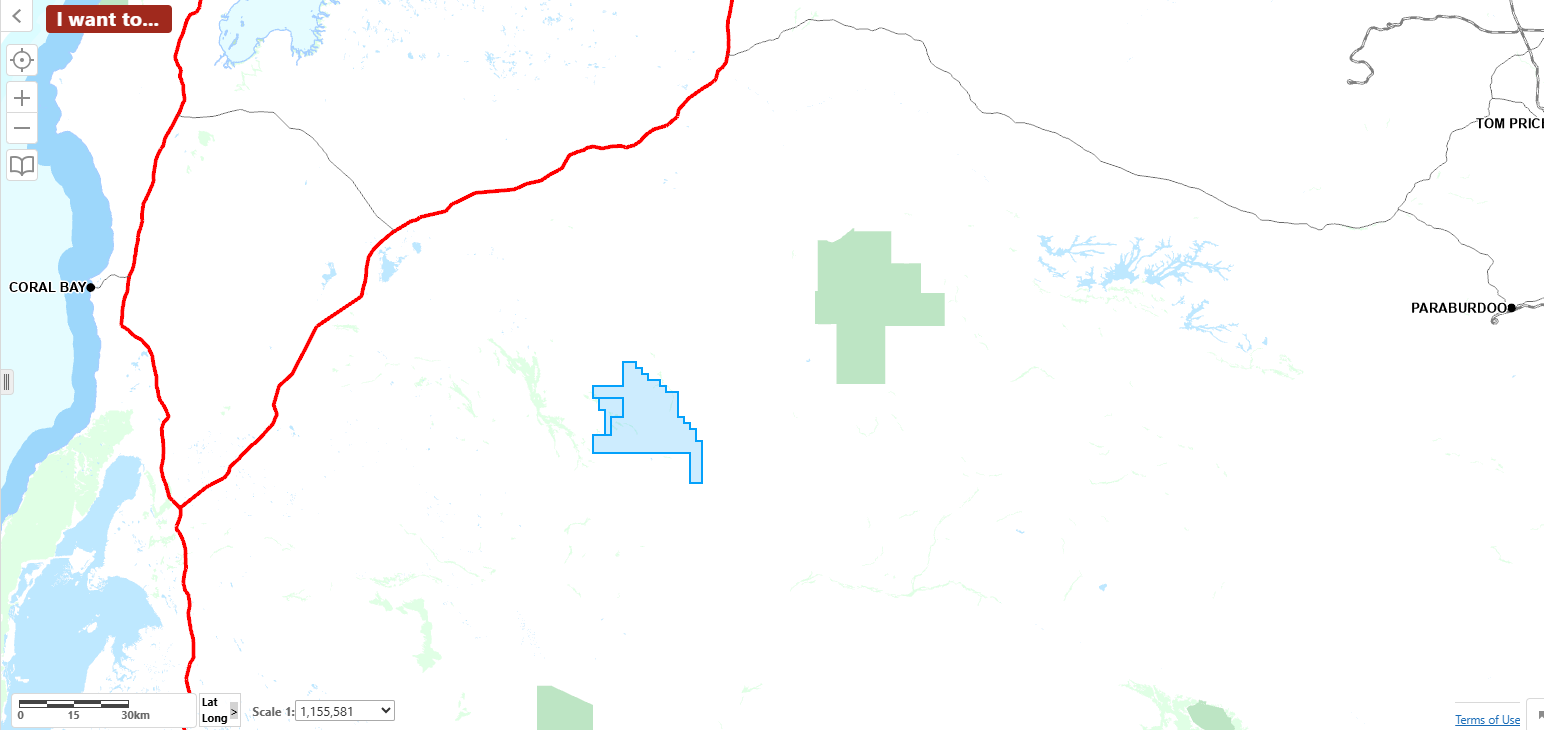
Figure 7 Location Plan
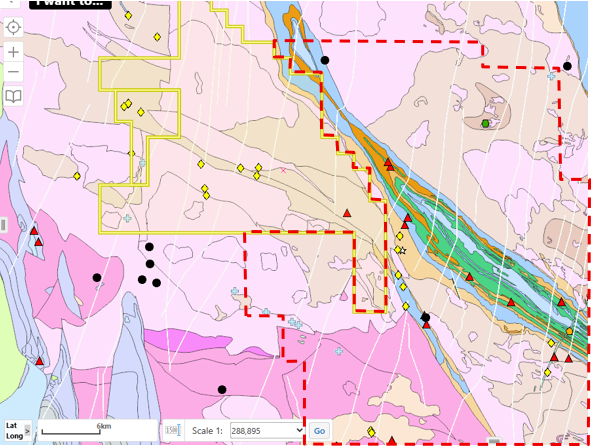
Figure 8 Gold mineralisation can be seen to be focussed on the meta sediments and dolerite dykes. The red dash is Dreadnought’s main Mangaroon Project. The extension of Midnight Star – Cullens Find is easily seen adjacent to Mambas Lease’s southern leg.
This regional setting is similar to the geological setting of the Glenburgh Gold Project (Benz Resources Limited) which contains ~1.0Moz of gold.

FOLLOW US

